
1. What Wine Teaches Us About Operational Excellence; Domain Expertise vs Cross-Industry Experience?
Act2Vision Operational Excellence Series – Blogpost 1
Is the end-to-end wine process your business? Probably not. But the forces that determine success in wine—discipline, timing, quality control, and market insight—are the same forces that shape performance in most industries. FIVE TAKE AWAYS for your business and why Operational Excellence using domain expertise and Crosss-Industry Experience is indeed an excellent start in whatever organisation.
In many situations, you need to look beyond your current horizon. Driven by competition, cost pressure, innovation, Artificial Intelligence (GPT, Co-Pilot, Gemini, IoT, Digital Twins, Tracking and Tracing, Suppluy Chain Visibility and footprints; our world keeps changing—and we have to adapt.
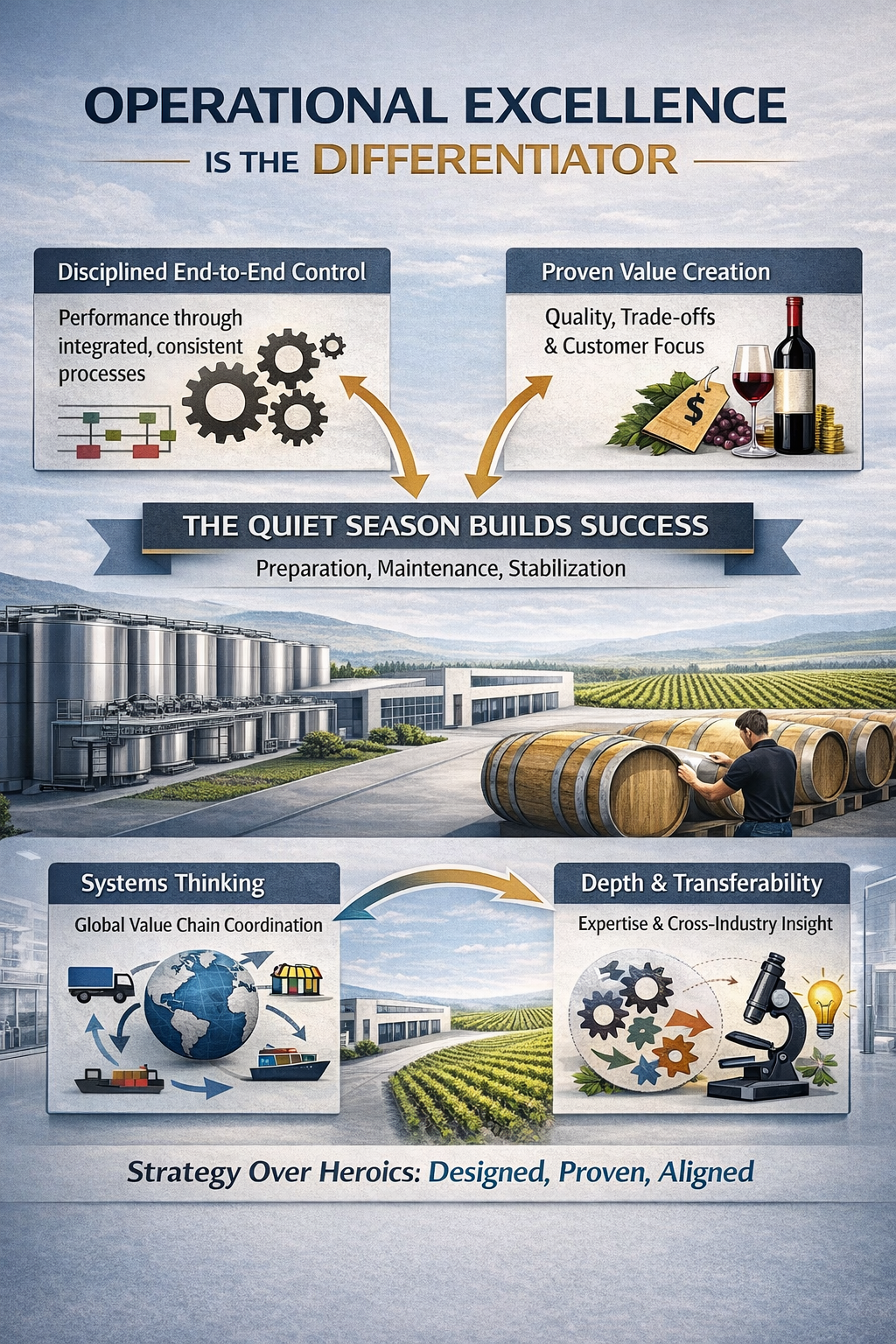
Operational Excellence as the Differentiator (Act2Vision, Food4TheBrain 2026)
2. Journey into Wine, in search for excellence.
2.1 About me.
Exploe and look beyond your current horizon. That mindset is why I founded Act2Vision in 2016: to share my knowledge and experience in operations and supply chain and translate it into practical, usable outcomes. My journey has taken me across boarders, sectors—from food to industry, and from machine assembly to broader end-to-end operations. The common thread has remained consistent: helping organizations build new capabilities, adopt new ways of thinking, and structured approach to perform better.
In 2025, I applied the change and adaption approach to myself and I entered the world of wine. I joined classes and completed WSET Level 2 and 3 to understand what truly drives success in Wine. What struck me immediately is how structured the domain is. Grape varieties, climate and terroir, vineyard management, winemaking choices, marketing, history, and culture—each variable influences quality and perception. None of it is accidental. Quality is engineered through controlled decisions, repeated over time. Value, too, is engineered. Wine comes with a price, and that price is only sustainable when the producer can consistently deliver and communicate value. That requires capability: the ability to distinguish quality signals, understand trade-offs, and pinpoint what makes a product worth paying for—objectively and consistently.
2.2 Even the seasons demonstrate this discipline.
In the northern hemisphere, winter may look like rest in the vineyard—but it is not. Dormancy is preparation. Pruning shapes the vine and directly affects yield and quality. Trellising systems are repaired and maintained. Frost protection is reviewed. Soil health is managed to support balance rather than uncontrolled vigor. The intent is not growth. The intent is control—limiting potential output to maximize fruit quality.
In the cellar, the work continues. Wines from the previous autumn harvest are stabilized, aged, and prepared for the next stage: racking, clarification, sulfite management, temperature monitoring, barrel maintenance, and blending decisions. Small interventions compound. Process control becomes product quality.
2.3 Zoom out and wine becomes even more instructive.
Wine is a global value chain—like coffee and cocoa. It requires people, operations, logistics, maintenance, procurement, sales, tastings, events, and marketing to bring a grape to market across a wide range of tastes, quality levels, and price points. And the market dynamics are shifting. Sparkling and organic wines are seeing increasing demand. Younger consumers and health-conscious trends are reshaping consumption patterns. Premium and super-premium wines are also gaining traction—particularly among younger consumers in emerging markets—where wine increasingly intersects with lifestyle and wealth.
There is more still: wine tourism boosts local economies and drives global sales as travelers bring discoveries home. E-commerce platforms serve both B2B and B2C channels. Packaging, bottle supply, shipment, transportation, taxes, and tariffs all influence margin and route-to-market strategy.
2.4 Wine and Data is available everywhere
Wine and Data is available everywhere: production, pricing, ratings, inventories, consumer behavior, and market forecasts—locally and globally.That data density creates an obvious opportunity: AI. Not only using professional datasets, but also leveraging user-generated data from wine apps, ratings platforms, and digital marketplaces. Preferences, willingness to pay, and demand signals are increasingly measurable—if you know how to translate data into decisions.
3. In search for Operational Excellence.
This leads to the real question: what is your business or your market and how do you value Domain Expertise vs Cross-Industry Experience?
What wine can teach your business. Using wine as a mirror, where are the parallels? What is fundamentally different—and more importantly, what can be transferred? I am interested in differences, and in the mutual success drivers that repeat across domains:
- Renewable energy,
- Machine building and assembly,
- Maintenance, Spare Parts,
- Inventory and Control,
- Food and packaging,
- Chemicals and processing.
Each of these fields deals with familiar patterns: people and skills, seasonality, volatile demand, changing markets, regulatory pressure, cost structures, and technology shifts. All drivers for execution Operational Excellence. The winners are not those with the most activity, but those with the clearest control of their system—and the strongest ability to adapt without losing quality. What wine can teach your business: balance deep expertise with cross-industry learning. Execute Opeartional Excellence to spot value and adapt faster.
This brings me to a second conclusion: depth and breadth must be deliberately balanced. Deep domain expertise and hands-on experience are essential to understand constraints, quality drivers, and real trade-offs. But that depth becomes far more powerful when paired with cross-discipline and cross-industry exposure—where pattern recognition improves, adaptability increases, and transferable levers become visible.
The advantage sits in the intersection: spotting potential early, translating it into a concrete approach, and executing it with discipline. Not expertise versus versatility—but expertise and versatility, in balance, applied with intent.
4. Five Key takeaways
-
Operational excellence is the differentiator: performance comes from disciplined control of variables end-to-end, not from isolated “hero work” or luck.
-
Value is designed and proven: strong products earn their price through consistent quality signals, clear trade-offs, and the capability to pinpoint what creates value for the customer.
-
The “quiet season” is where outcomes are built: preparation, maintenance, and stabilization work upstream is what determines downstream results—small interventions compound.
-
Think in systems, not functions: wine succeeds as an integrated global value chain (operations, logistics, procurement, sales, marketing, channels, compliance), where coordination is as critical as craftsmanship.
-
Combine depth with transferability: domain expertise provides constraint awareness; cross-industry exposure improves pattern recognition—together they enable faster adaptation and better execution.

Food4TheBrain (2026)
Operational Excellence. Building process clarity today for the value chain of tomorrow.
Maarten van Oost@act2vision.nl | +31 (0) 686 698 026 | Amsterdam, Netherlands, EEA
- Blogpost series: Supply Chain Digital Twins
- Blogpost series: Carbon Capture and Storage
- Blogpost series: Operational Excellence