
Operational Excellence (OpExc) is a term that is often used, but is rarely sharply defined. It is confused with Lean, Six Sigma, cost reduction or “working more efficiently”. In reality, Operational Excellence is not a toolset and not a one-off improvement program. It is the way in which an organization performs structurally.
In article 1/5 of this series, we laid the foundation: why Operational Excellence makes the difference, and why performance in any sector or industry comes from multidisciplinary collaboration and disciplined control of variables end-to-end — not chance or hero work. In this second article (2/5) we take a deepdive into one key question: what exactly is Operational Excellence?
1. Wat is Operational Excellence?
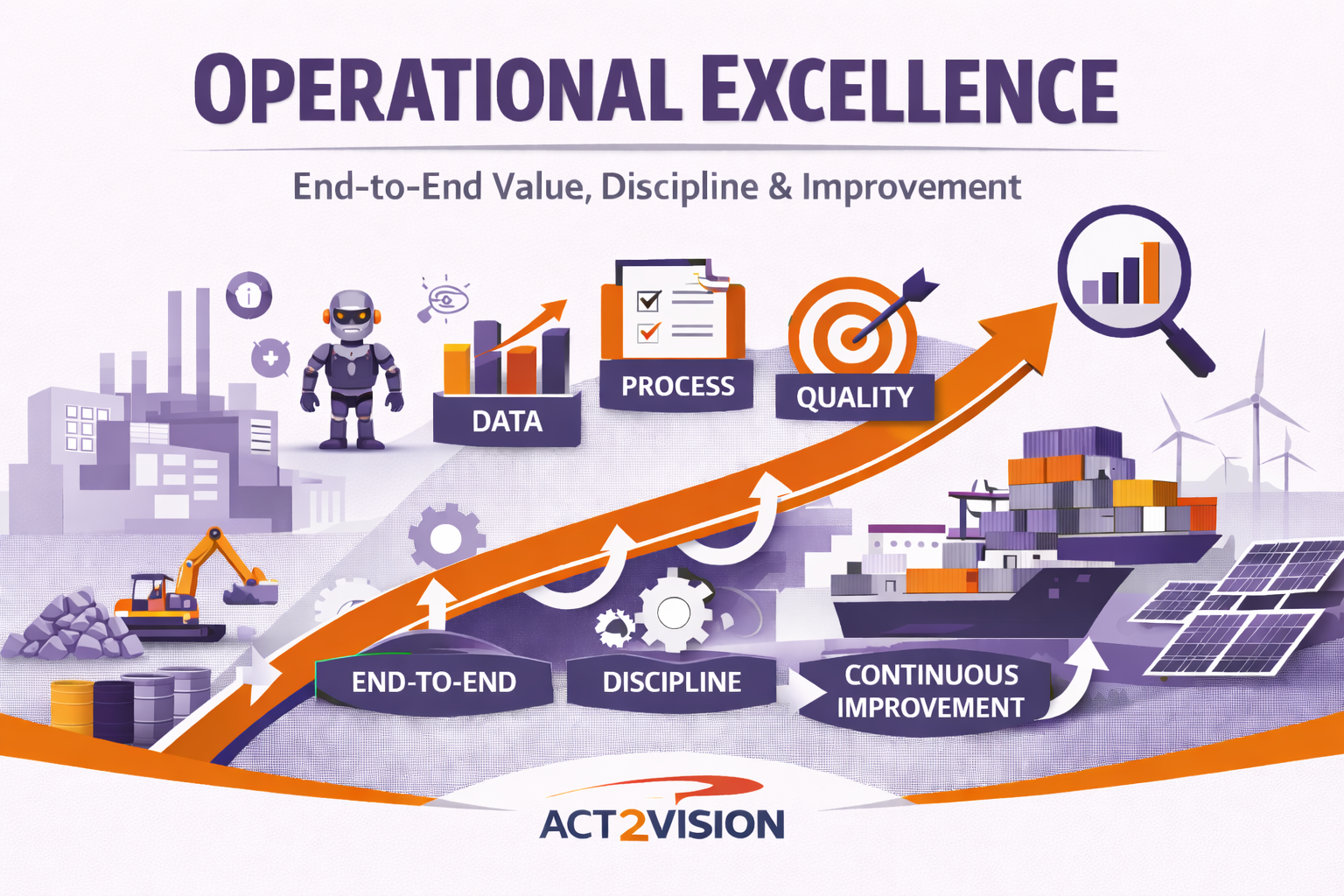
Operational Excellence is the ability of an organization to consistently deliver value to the customer, at a manageable cost, with predictable performance, while at the same time being able to adapt to changes in market, technology and regulations. Its the foundation for structural performance.
Three elements are crucial in this respect.
- End-to-end thinking. Operational Excellence does not look at individual departments or individual KPIs, but at the entire system: from demand and design to delivery and service. Local optimization — for example, an efficient factory that makes the wrong products — always undermines the overall system performance.
- Multidisciplinary, disciplined process control. Performance is not a coincidence and not a result of individual effort. They arise from explicit choices, standards, feedback loops and clear ownership. Variation is not ignored, but understood and controlled.
- Continuous improvement based on facts. Operational Excellence is dynamic. It is not about one optimal state, but about structurally improving performance based on data, learning and adaptation.
2. How do you recognize Operational Excellence in practice?
In mature organizations, you see Operational Excellence as:
– predictable and stable output – transparent performance across the entire chain – explicit trade-offs between quality, service, costs and flexibility – improvements that are guaranteed*, not in individuals
* in marketing, products and services, competition, installations, systems, processes, organization and culture
3. Operational Excellence is NOT..
Operational Excellence is not a synonym for Lean, Six Sigma or TPM. These are methods that can contribute to better performance, but they are not the end in themselves. Nor is Operational Excellence purely cost reduction. Costs often fall as a result of better control, but OpEx starts with value and reliability.
Operational Excellence is therefore not a “project”, but a capability: the organizational ability to understand, manage and improve the system. This requires clear design (processes and management), discipline in implementation (standards and behaviour) and feedback based on facts (measurements that lead to decisions).
4. Key takeaways – Operational Excellence
- Operational Excellence is a capability, not a project. It is a structural organizational capability, not a temporary improvement program.
- End-to-end performance is leading. Local KPI optimization harms the system as a whole.
- Performance comes from discipline, not chance. Standards, choices, and ownership determine results—not hero work.
- Variation is controlled, not ignored. Operational Excellence makes variation visible and controllable.
- Continuous improvement is fact-driven and secured. Improvements are based on data and are structurally embedded.

Food4TheBrain (2026)
Operational Excellence, Building process clarity today for the value chain of tomorrow.
info@act2vision.nl | +31 (0) 686 698 026 | Amsterdam, Netherlands, EEA
- Blog series: Operational Excellence (2/5)
- Blog series: Supply Chain Digital Twins
- Blog series: Carbon Capture and Storage